Get called
Demonstration
To process your request, we need to process your personal data. Find out more about the processing of your personal data here.
Since 2006, this day has marked the international commitment to data protection, in homage to the 1981 Council of Europe Convention 108, the first treaty on digital privacy.
Its aim? To raise public and corporate awareness of the crucial issues of data security and protection in an increasingly connected world.
On January 16, 2025, the CNIL (National Commission for Information Technology and Civil Liberties) unveiled its 2025-2028 strategic plan with a clear objective: to strengthen personal data protection in the face of digital challenges. Here are the 4 priorities that will impact businesses and citizens alike.
→ The CNIL (National Commission for Information Technology and Civil Liberties) wants an ethical and secure framework to guarantee responsible AI.
→ The CNIL (National Commission for Information Technology and Civil Liberties) demands secure platforms suitable for minors, with greater awareness among parents.
61% of French people were victims of cyberattacks in 2024 (hacking, fraud, viruses).
→ The CNIL (National Commission for Information Technology and Civil Liberties) is stepping up its actions to prevent cyberthreats and secure digital tools right from the design stage.
→ Objective: guarantee privacy-friendly practices and put the user back at the center of decision-making.
These measures will have an impact on companies, digital platforms and all users. Anticipate these changes now to remain compliant and protect the data of your clients, employees and partners.
On January 28, 2025, the French National Assembly adopted a shock measure: a total ban on BtoC telephone canvassing without consent. A direct response to the failure of the Bloctel system.
The text, adopted unanimously, still has to be validated by the Senate. Stay tuned, we'll keep you informed of the next steps!
✔ BtoC: No more unsolicited calls! You must now obtain prior consent from individuals before any telephone prospecting.
✔ BtoB: No change, telephone canvassing remains authorized without prior consent.
Two major French e-commerce brands were recently targeted by a Credential Stuffing attack .
How does it work? Hackers use hacked databases containing e-mail/password pairs and automatically test them on various sites (e-commerce, social networks, online platforms).
Their objective? Data theft, financial fraud and identity theft.
Don't let your credentials become a gateway for cybercriminals!
- Activatemulti-factor authentication (MFA).
- Use unique, complex passwords.
- Detect and block suspicious connections.
- Limit connection attempts to counter bots.
- Make your teams aware of good cybersecurity practices
On December 19, 2024, a real estate company was sanctioned by the CNIL (National Commission for Information Technology and Civil Liberties) for excessive surveillance of its employees. The case, revealed on February 4, 2025, sends a clear message: employee surveillance must comply with the law, or face heavy penalties.
The company had set up :
Serious shortcomings pointed out by the CNIL (National Commission for Information Technology and Civil Liberties) ):
The company was fined €40,000.
The call to order is clear: verify, yes, but not just any old way! A company must guarantee transparency, proportionality and respect for rights, on pain of heavy penalties.
Artificial intelligence has a surprising peculiarity: rather than admitting it doesn't know, it invents an answer.
How is this possible? It has to do with the way it works, which is based on probability calculations and not on a true understanding of meaning or verification of facts.
The result? One answer may seem credible... but isn't really!
- Ask for sources: Information without a source? Beware! Always check that the AI cites reliable references.
- Cross-referencing information: Reliable data needs to be confirmed by several independent sources. Don't rely on a single answer.
- Keep a critical eye: Analyze coherence, spot contradictions and be alert to possible biases.
AI is a tool, not an absolute truth! Always use it with care and discernment.
On January 27, 2025, a new player in generative AI entered the scene: DeepSeek, a Chinese AI with ambitions to rival ChatGPT... but at 96% less cost ($6 million vs. $2.85 billion for OpenAI). An impressive competitive advantage, but at what price?
But as soon as it was launched, DeepSeek was already at the heart of a major scandal... A massive leak of sensitive data was revealed: logs, private conversations, API keys... In other words, a catastrophe for user confidentiality!
Avoid using American or Chinese tools to develop your functionalities. Your clients won't take the risk of having their data transferred without their consent and will prefer GDPR providers.
At Dipeeo, we go beyond GDPR compliance. We support you in your technological choices to transform GDPR into a true business ally for your company.
| The Artificial Intelligence Regulation (AIR), in force since August 1, 2024 across the EU, imposes strict rules to frame the use of AI. Don't miss out: follow these 3 key actions to avoid sanctions. |
Identify all the AI tools used in your company: recommendation, internal management, AI assistants. .. Nothing should be left to chance.
Each AI must be assessed to determine which obligations apply.
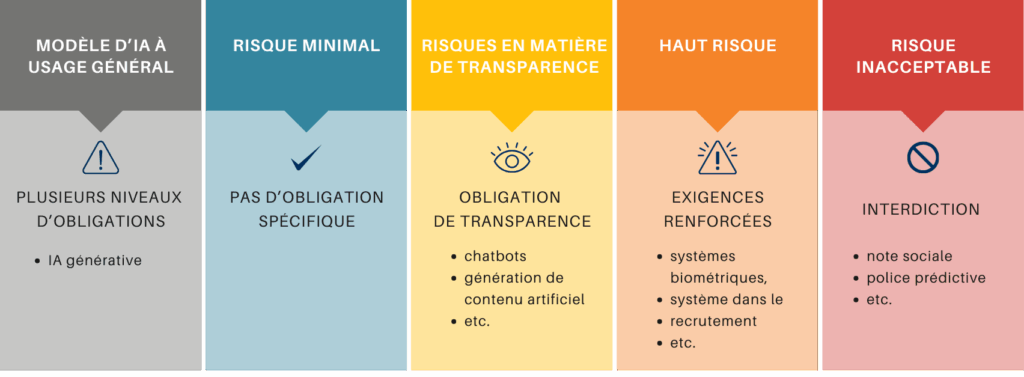
✔ Add your AI systems to your processing register (already required by the GDPR).
✔ Update your privacy policy and information systems charter to clearly inform your users.
✔ Need help? Call on Dipeeo to carry out a full impact analysis, assess the risks of your high-risk AI and demonstrate your compliance.
Get ahead of the game: discover how to master GDPR issues related to AI and explore a GDPR AI solution.


